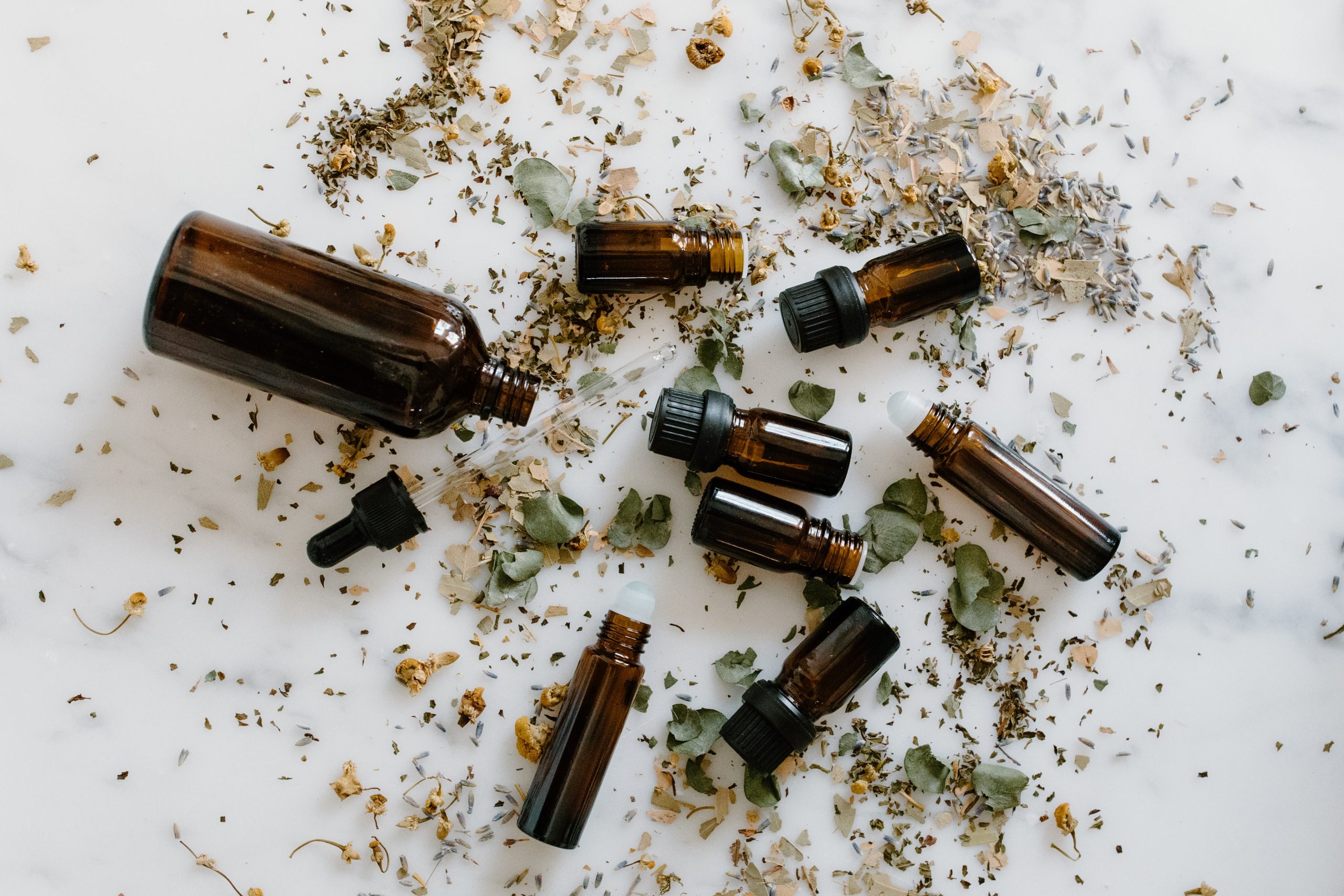
Essential Oil Production Equipment
Which technology do you need?
There is currently no equipment listed with your specified properties, but we are sure we can help you. Try us! Contact us
Tell us about your production challenge
Keep temperatures to a minimum in the hydrodistillation process
Hydrodistillation techniques employ hot water to isolate the essential oil from the aromatic plant. In the case of extraction by thermal decomposition, you heat a mixture of water and plant material allowing the oils to evaporate. However, since almost all constituents of essential oils are unstable at high temperatures, heat levels need to be kept to a low.
The vapor is then liquefied in a condenser and collected in a tank. The immiscibility of water and oil forms a natural separation of the two liquids. High extraction temperature can lead to thermal decomposition reactions of some plant constituents.
Essential oil extraction system using microwave technology
Microwave-Assisted Extraction (MAE) applies heat to the plant’s cell wall through radiation. The technology hits the raw material with non-ionizing electromagnetic waves at frequencies between 300 MHz to 300 GHz.
The cells swell up, causing the plant walls to rupture and the oils to leach out. Essential oil extraction systems using MAE may be either closed or open units. Closed systems reach a maximum power range between 600 W and 1000 W, while open systems operate at around 250 W.
Fill up your storage tanks to prevent oxidation
Storing the essential oil in half-filled tanks exposes the material to oxidization and may trigger a change in its chemical profile.
At low temperatures, oxidation is driven by peroxyl radicals and hydroperoxides. On the other hand, as high temperatures reduce oxygen availability, the process is caused by alkyl or hydroxyl radicals.
The antimicrobial properties of essential oils can be formulated into pesticides.
Essential oils perform several pharmacological activities, such as antifungal and antimicrobial effects. The extracts are being used as protective additives in crop production. Their natural antioxidant properties can control fungi growth in cereals and other agricultural produce.
Biocides made from essential oils can be combined with conventional pesticides to extend the shelf lives of traditional fungicides.
Let's talk about your project!